Using AI for Social Media Without Losing Your Audience
Almost every social marketer now uses AI, while roughly a third of consumers trust a brand less the moment they notice it. That gap, not the tooling, is the thing to manage.
Updated
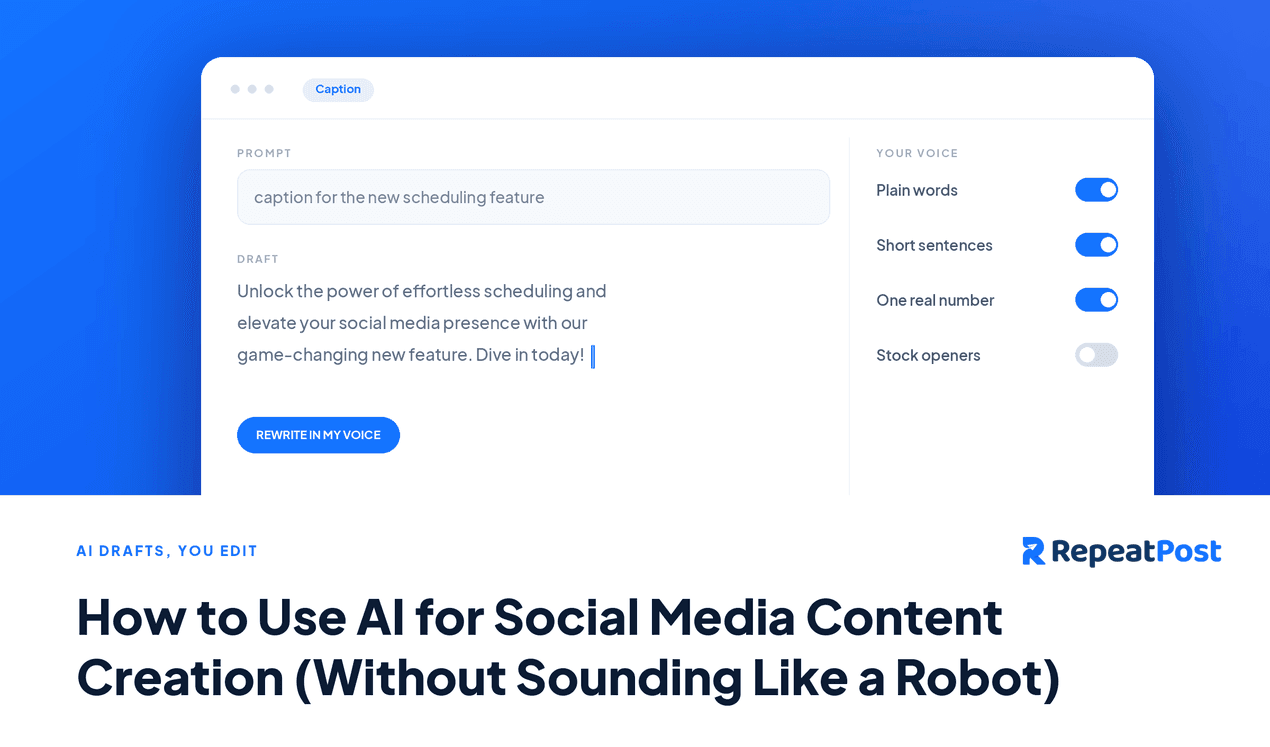
Ninety four percent of social media marketers now use AI in some part of their workflow. Thirty one percent of consumers trust a brand less when they notice AI generated content.
Both numbers come from 2026 surveys with real samples behind them, and together they describe the actual problem. The question stopped being whether to use AI some time ago. It is now how to use it without paying the trust penalty that comes with being caught.
The adoption numbers
HubSpot surveyed more than 1,100 social media professionals for its 2026 report. The headline is that 94% use AI in their workflows in some capacity, but the breakdown is more useful than the total.
- Ideation and brainstorming: 42.9%
- Captions and short form text: 41.5%
- Image generation: 38.35%
- Image editing: 34.78%
- Social listening only: 13.54%
The same survey asked where AI fell short. Image generation topped that list too, at 40.2%, followed by image editing at 29.58% and video generation at 28.7%.
Read those two lists together and a pattern appears. The things marketers use AI for most are also the things it disappoints them at most. Text tasks barely feature in the complaints.
Among agencies the time savings are concrete. AgencyAnalytics surveyed 494 agency professionals in early 2026 and found 79% save five or more hours a week, and 35% save ten or more. The single largest gain was not writing but reporting and summaries, at 42%.
The number nobody puts in the deck
Klaviyo surveyed 8,000 consumers across eight countries in December 2025. When people notice AI generated content from a brand:
- 31% trust that brand less
- 7% trust it more
- 55% say they are uncomfortable with AI generated brand marketing on social media
That is a four to one ratio against. And the industry does not appear to know it. The IAB asked both sides the same question and found that 82% of advertising executives believe consumers feel positive about AI generated ads, while only 45% of consumers actually do. The gap widened from 32 points in 2024 to 37 points in 2026.
Among Gen Z the sentiment is sharper still: 39% feel negative about AI generated ads, against 20% of Millennials, and negative sentiment rose 12 points year on year.
The IAB samples are small, 505 consumers and 104 executives, so treat the precise figures with care. The direction is consistent with the much larger Klaviyo study, and both point the same way.
The distinction that actually governs disclosure
Here is the part almost nobody writes up correctly, and it resolves most of the anxiety about AI labelling.
Every major platform draws its disclosure line at realistic synthetic depictions, not at AI assistance. YouTube is the most explicit. It requires disclosure for three things: making a real person appear to say or do something they did not, altering footage of a real event or place, and generating a realistic scene that did not occur.
And it explicitly exempts:
Production assistance, like using generative AI tools to create or improve a video outline, script, thumbnail, title, or infographic.
YouTube also states that disclosing will not limit a video's audience or affect its eligibility to earn money.
The other platforms are consistent with this. Meta applies AI Info labels triggered by industry standard indicators or user disclosure. TikTok uses C2PA Content Credentials plus invisible watermarking, and gives users a slider to see more or less AI content. LinkedIn adopted the same C2PA standard in 2024.
So if you used a model to draft a caption, outline a carousel or suggest a hook, no platform requires you to say so. If you generated a photorealistic image of something that never happened, every one of them does.
That distinction is not a loophole. It maps neatly onto what audiences actually object to. People are not upset that a caption was drafted with help. They are upset at being deceived about what is real.
What this means in practice
The trust penalty attaches to content that reads or looks generated, not to content that had help. So the working rule is straightforward: use AI where it does not show, and do the work yourself where it does.
Where it does not show
Research and summarising. Turning one piece of content into outlines for several formats. First drafts you will rewrite. Alt text. Reformatting a long post for a different platform's conventions. Reporting and analysis, which is where agencies measure the biggest savings anyway.
Where it shows immediately
Opinions. Specific numbers from your own experience. Anything with a point of view. The particular detail that proves you were actually there. A model can produce a competent paragraph about social media strategy; it cannot tell your audience what happened when you tried something and it failed.
That is not a limitation to work around. It is the part of your content that has value, precisely because it cannot be generated.
On the performance data
Buffer studied 1.2 million posts from 15,000 users who created both AI assisted and unassisted content. Median engagement rate came out at 5.87% for AI assisted posts against 4.82% for the rest.
Buffer's own caveat matters more than the headline:
The most engaged users, who are naturally more likely to use the AI assistant, are skewing the median engagement rates upward.
Buffer explicitly cautions against inferring causation, and hypothesises that volume and consistency, rather than AI itself, drive the difference. The study is also from October 2024, which makes it the oldest evidence in this article.
Read honestly, it does not show AI improves content. It shows that people who post a lot use AI, and people who post a lot get more engagement. That is still worth knowing, just not for the reason it usually gets quoted.
A workflow that respects both findings
- Use AI for the blank page, not the final draft. Getting to a rough structure quickly is where the time saving genuinely is.
- Rewrite every sentence you would not have written. If a line could have appeared on any competitor's account, it is doing nothing for you.
- Add one thing only you know. A number from your own analytics, a mistake you made, a customer's actual words. This is the part that earns trust.
- Never generate people, places or events that look real. That is where disclosure obligations begin and where audience trust collapses.
- Point AI at reporting. Agencies measure their largest savings there, and nobody is emotionally invested in how a performance summary was drafted.
If you are producing across several platforms, adapting one idea per channel is where the time goes. Our multi channel strategy guide covers doing that without publishing the same thing everywhere, and RepeatPost's AI tools sit inside the editor so drafting and scheduling happen in one place rather than across three tabs.
The short version
Almost everyone uses AI now, so using it is not an advantage. Avoiding the trust penalty is.
Roughly a third of consumers think less of a brand when they notice AI content, and the industry substantially overestimates how relaxed people are about it. No platform asks you to disclose AI assistance, only realistic synthetic depictions, which tells you where the real line sits.
Use it to get to a draft faster. Then put yourself back into it. Our scheduling guide covers batching the output, and you can browse the free AI tools if you want to try the drafting side without signing up for anything.