Multi Channel Social Media Strategy That Stays Sustainable
Barely 1% of YouTube's audience is unique to YouTube. Once you know that, the case for being on every platform gets much weaker, and the case for adapting rather than copying gets much stronger.
Updated
Barely 1% of YouTube's users are unique to YouTube. For TikTok, Snapchat, X and Telegram the figure is around 0.1%. Roughly 99.3% of Facebook users can be reached on at least one other platform.
That is DataReportal's analysis, and it quietly undermines the main argument for being everywhere. You are not reaching six separate audiences. You are reaching substantially the same people in six places, and paying six times to do it.
The numbers worth knowing first
People use about 6.5 platforms a month. That is GWI data reported through DataReportal, and it is usually presented as a reason to be on all of them.
Brands run 4.5 profiles on average. SocialBee analysed 9,332,840 posts across ten networks. The distribution is more revealing than the average: 39.5% of brands run one or two profiles, 28.1% run three or four, 32% run five or more, and 6.4% run eleven or more.
Those audiences are almost entirely the same people. This is the finding that reframes the other two. DataReportal's conclusion is direct: you can reach almost all of the users of any given social platform on at least one other platform.
So the question is not how many audiences you can reach. It is how many times you want to reach roughly the same audience, and what each additional channel costs you in attention.
Start with two or three, properly
The case for concentration is not just workload. It is that presence without depth does not accomplish much on platforms that rank by engagement.
Pick based on where your audience already behaves the way you need them to. A B2B consultant does not need TikTok. A visual product brand does not need a LinkedIn company page as its first move. What matters is matching the platform's dominant format to what you can actually sustain producing.
Then go deep enough to clear the frequency thresholds that have measurable effects. Buffer found Instagram accounts posting three to five times a week saw roughly 12% more reach per post than those posting once or twice. Spreading the same effort across five platforms puts you below that threshold everywhere.
Why copying the same post across platforms fails
Two reasons, and the first is documented policy rather than folklore.
Instagram explicitly targets unoriginal content. Its Original Content Guidelines state that watermarks, borders, speed changes and crediting the original creator do not count as material edits. The test Instagram gives is worth quoting because it is a genuinely useful editorial standard:
if someone could remove your contribution to your post or reel, and the content would virtually be the same, it probably needs more of you in it.
Accounts posting primarily unoriginal content become ineligible to appear in recommendations. Eligibility returns when most of an account's recent posts are considered original over a 30 day period. In April 2026 Instagram extended this beyond video to photos and carousels from aggregator accounts.
Format preferences are close to inverted across networks. Buffer's analysis of 52 million posts found LinkedIn carousels reach a median engagement rate of 21.77% against 3.18% for text posts. On X, text posts beat video, 3.56% against 2.96%. On Instagram, carousels win on engagement at 6.90% against 3.31% for Reels, while Reels get 36% more reach.
A carousel is the best thing you can post on LinkedIn and one of several reasonable options on Instagram. Text is the weakest format on LinkedIn and the strongest on X. There is no single artefact that is simultaneously optimal in both places.
One honest caveat. Despite how often you will read that cross posting carries a specific reach penalty, there is no reliable data putting a number on it. Claims of 34% higher reach from automated cross posting, or 42% lower reach from neural fingerprinting, trace to no study at all. The documented risk is Instagram's recommendation ineligibility, not a mysterious algorithmic tax.
Create once, adapt everywhere
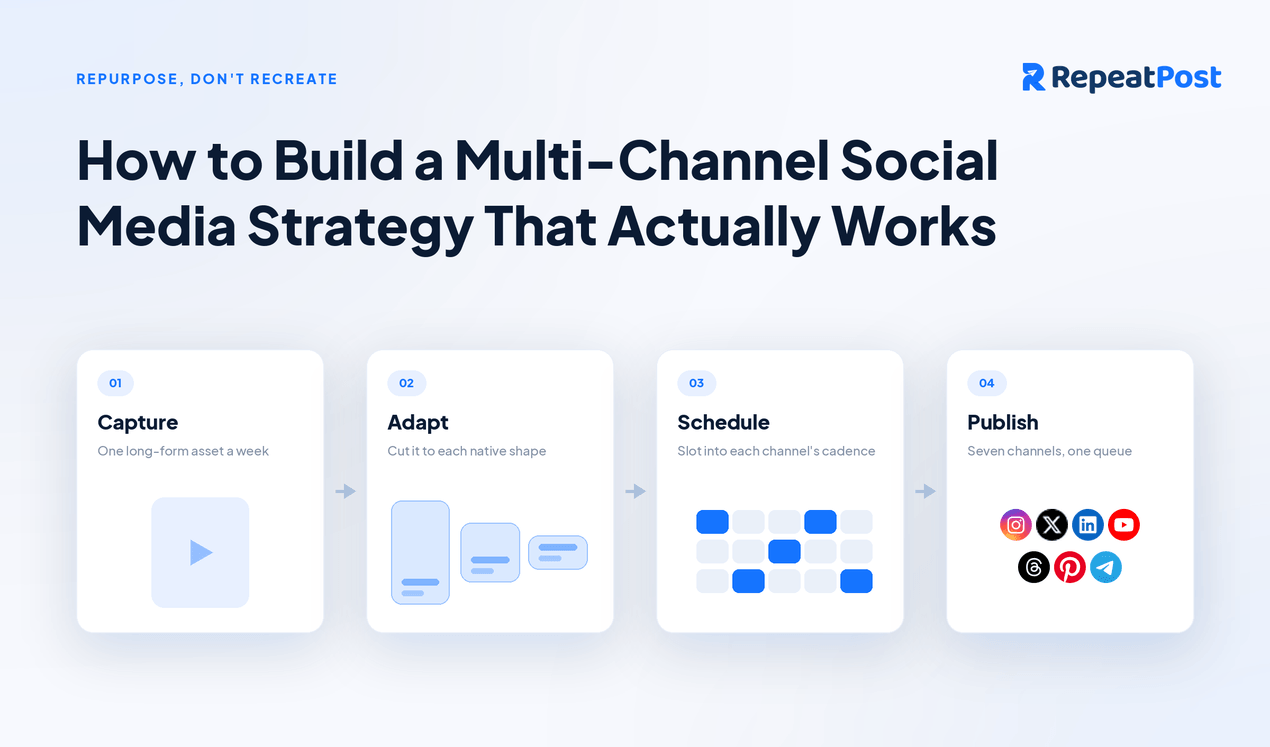
The workable model is one substantial piece of thinking, reshaped per platform. Adaptation means changing the format and the framing, not adding a border.
A piece of original research becomes a LinkedIn document carousel leading with the counterintuitive finding, an Instagram carousel leading with the single most striking number, a short video walking through how you gathered the data, and a text thread on X making the argument in sequence.
A customer conversation becomes a LinkedIn post about the pattern it revealed, a short video answering the question they asked, and a caption pairing their words with the outcome.
In each case the underlying insight is shared and the artefact is genuinely different. That satisfies Instagram's originality test, respects each platform's format preferences, and takes meaningfully less time than inventing four unrelated ideas.
Measure each platform on its own terms
Comparing raw engagement rates across networks tells you almost nothing, because the baselines differ enormously and so do the denominators.
Buffer's 2025 medians give a sense of the spread: LinkedIn around 6.2%, Facebook 5.6%, Instagram 5.46%, TikTok 4.6%, Pinterest 4.0%, Threads 3.6%, X 2.5%. The year on year movement varied even more sharply, with X up 44% and Instagram down 26% over the same period.
An Instagram account whose engagement fell last year may have done nothing wrong. The platform median fell about 26%.
Different publishers also measure differently enough that their numbers are not comparable at all. Buffer puts X's engagement rate around 2.5%; Socialinsider puts it at 0.12%. Neither is wrong. They use different denominators on different account populations. Never average figures like these, and be wary of any article that does.
A workable setup
- Choose two or three channels based on format fit, not audience size. The audiences overlap almost completely anyway.
- Hit the frequency threshold on each. Three to five posts a week on Instagram, LinkedIn and TikTok; more on X. Below that, added channels dilute rather than extend.
- Adapt the format per platform. Carousels and documents on LinkedIn, video for reach on Instagram, text on X.
- Keep one calendar. Seeing every channel in one view is what stops accidental duplication and reveals gaps.
- Set per platform benchmarks. Compare each channel with its own history, never with another channel.
Adding a channel is a real commitment, not a checkbox. The honest test is whether you can sustain the cadence that makes it work.
The short version
Being on more platforms does not reach more people. It reaches roughly the same people more often, at a cost that scales with each addition.
Pick two or three where the format suits what you can produce. Create one substantial thing and genuinely reshape it per platform, because Instagram's guidelines target the alternative directly and format preferences are close to inverted across networks. Measure each channel against itself.
Our guides to Instagram, LinkedIn, TikTok and X cover what each platform rewards. If you are running several, RepeatPost connects 16+ channels to one calendar with per channel customisation in a single editor, and analytics that compare each channel with its own baseline.