How Agencies Manage Multiple Social Media Clients
Most agencies lose clients to budget cuts rather than bad work, and approvals are the single biggest workflow bottleneck. Survey data from 494 agency professionals on what actually breaks.
Updated
Most agencies do not lose social media clients because the work was bad. They lose them because the client cut budget, restructured, or stopped seeing the value in what was already being delivered.
That comes from AgencyAnalytics, which surveyed 494 agency professionals in early 2026. It reframes what scaling a client roster actually requires, because the failure modes are mostly not creative ones.
What the churn data shows
The causes agencies reported, in order:
- Budget cuts and economic pressure: 42%
- Client side internal changes: 37%
- Perceived value decline: 32%
- Performance misalignment: 31%
- Attribution and ROI clarity issues: 10%
Two of the top three are largely outside your control. The third, perceived value decline, is the interesting one, because perceived is doing real work in that phrase. A client who cannot see what you did will conclude you did less than you did.
The retention side confirms it. Asked what keeps clients, agencies named strong relationships at 80% and effective communication at 69%, well ahead of campaign performance at 39% and transparent reporting at 32%.
Read those two lists together and the conclusion is uncomfortable for anyone who believes good work speaks for itself. It does not. Communication is the retention mechanism, and visible reporting is how perceived value stays attached to actual value.
Retention is generally healthier than the industry's reputation suggests: 62% of clients stay two years or more, 43% stay two to five years, and 19% stay beyond five.
One caveat worth stating. That survey covers marketing agencies broadly, not social media agencies specifically. The patterns are likely to transfer; the exact percentages may not.
Client loads in practice
The distribution across 494 agencies:
|
Clients |
Share of agencies |
|---|---|
|
1 to 5 |
6% |
|
6 to 15 |
25% |
|
16 to 25 |
20% |
|
26 to 50 |
17% |
|
51 to 100 |
18% |
|
101 or more |
13% |
Nearly half sit between six and twenty five clients, and 49% of respondents work at agencies of one to ten people. So the common case is a small team carrying a load that only works with systems behind it.
On per manager loads, Databox found nearly 70% of agencies say account managers handle fewer than ten clients each, and more than 10% assign fifteen or more. That survey covered 48 agencies, which is small, and it is the only data we could find on the question. Treat it as a rough signal.
Approvals are the bottleneck, and it is measured
Planable surveyed 1,000 marketers and found more than 40% struggle with content reviews and approvals. That was the single largest bottleneck reported. Over 30% reported friction in reporting and analytics, and only 12% reported no bottlenecks at all.
The same survey found 37.5% manage social media alone, 43.9% use just one or two tools, and 21.7% juggle five or more.
That last pair explains a lot. Approval friction is rarely about the reviewing itself. It is about approval happening across email, a spreadsheet, a chat thread and a shared drive, so nobody can tell what state anything is in. The fix is not faster reviewers. It is a single place where draft, review and approved are visible states rather than inferred from message history.
Note also that a version of Planable's finding circulates as 47%. Planable's own page says over 40%. Use theirs.
Reporting is a solved problem for most
Among the agencies surveyed, 46% produce a client report in under 30 minutes and 27% take 30 to 60 minutes. But 16% take one to two hours and 11% take more than two.
At twenty clients, a two hour report is a full working week every month spent assembling numbers.
The gap between the 46% and the 11% is almost entirely templating and data access. Clients want to see what was published, how it performed, what changed, and what happens next. That is four sections, and it does not need rebuilding monthly.
Given that transparent reporting is named a retention driver by only 32% of agencies while communication is named by 69%, there is a case for making reports shorter and more frequent rather than longer and monthly. The point is that the client keeps seeing the value, not that the document is comprehensive.
Where AI is actually helping agencies
The same survey found 79% of agencies save five or more hours a week using AI, and 35% save ten or more.
The largest reported gain was reporting and summaries at 42%, not content creation. Agentic workflow automation came in at 38%.
That is worth sitting with, because it points at the opposite of where most agencies apply AI first. The measured saving is in the administrative layer, which is also where nobody minds. Our guide to using AI without losing your audience covers why the creative side carries a trust cost that reporting does not.
Five systems that address the actual failure modes
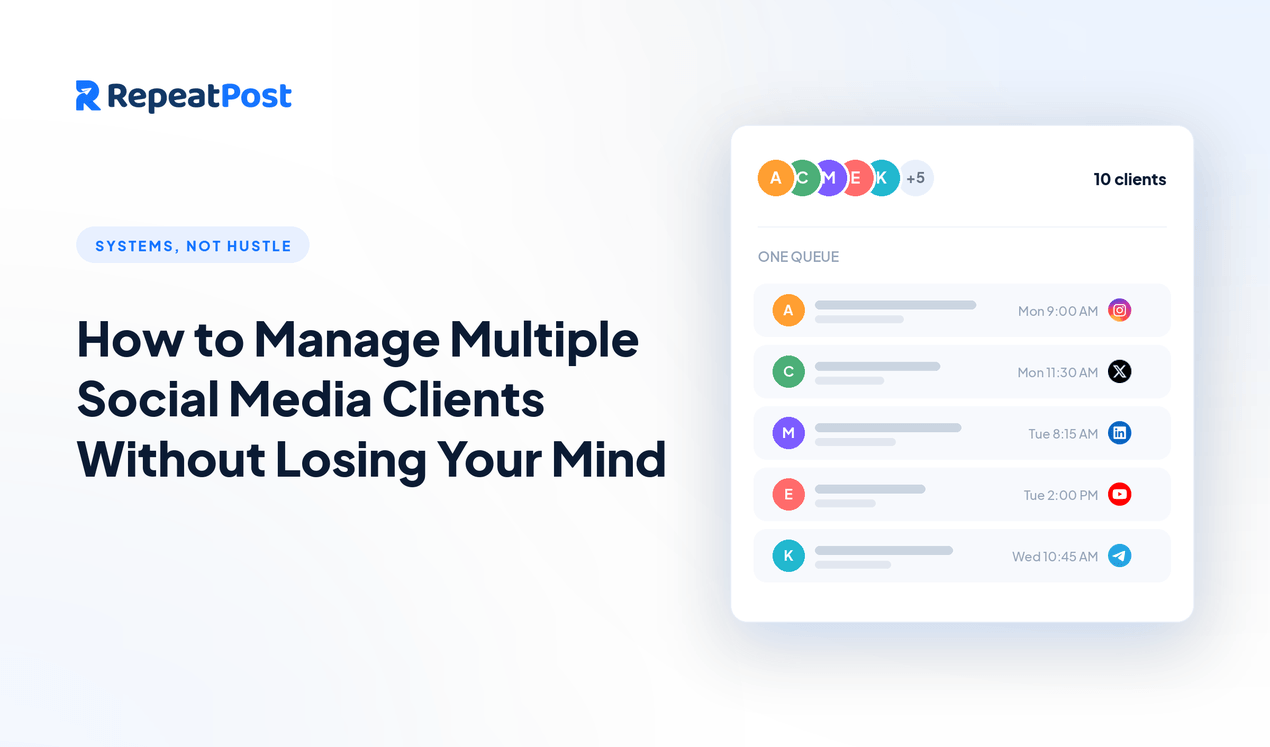
- Separate workspaces per client. The catastrophic error in this business is posting the right content to the wrong account. That is a structural problem, solved by never having two clients' channels in the same view, not by being careful.
- One approval state per post. Draft, in review, approved, scheduled. Visible to everyone, in one place. Approvals are the measured bottleneck, and most of that friction comes from state living in message threads.
- Role based access. Creators draft, managers approve, clients review. This limits the blast radius of a mistake and, just as importantly, gives clients confidence that nothing publishes without sign off.
- Templated reporting. Get to the under 30 minute group. Same four sections monthly: published, performance, what changed, what is next.
- Batch per client, not per task. Harvard Business Review research across 137 workers found application switching cost just under four hours a week, about 9% of working time. Switching between client contexts carries the same kind of overhead, and it compounds with roster size.
None of this is glamorous. But look back at the churn data: budget cuts, internal changes, perceived value decline. Systems will not stop a client's budget being cut. They will stop the third one, and they will keep you from losing a client to a preventable error while you are busy with another account.
The short version
Scaling a client roster is an operations problem more than a creative one.
Clients leave for budget and structural reasons far more often than for bad work, and the leading retention drivers are relationship and communication rather than campaign performance. Approvals are the measured bottleneck. Reporting is where agencies waste the most recoverable time, and also where AI is delivering the largest measured savings.
RepeatPost for agencies provides separate workspaces per client, approval workflows with visible states, role based permissions, and unified analytics across 16+ channels so a monthly report is assembly rather than archaeology. Our scheduling guide covers batching, and the multi channel strategy guide covers keeping several clients' channels sustainable at once.