Social Media Scheduling: What the Data Actually Supports
The study everyone cites to prove scheduling tools are safe found photos performed 32% worse through them. Here is what the evidence actually supports about scheduling, batching and cadence.
Updated
Almost every article about scheduling opens by reassuring you that platforms do not penalise scheduled posts, usually citing a figure of 10.3% more engagement.
That number is real. It is also from 2020, it belongs to Sendible rather than Buffer as it is usually credited, and the study it comes from found that photos performed 32.2% worse and videos 20% worse when published through a third party tool. Only links did well, at 52.9% better.
Since most social content is photos and video, quoting the aggregate on its own gets the answer backwards.
What the evidence on scheduling tools actually shows
Two studies matter here, and both have real limitations worth stating.
Sendible, November 2020. More than 5,000 posts from 58 Facebook pages ranging from 196 to 6.6 million fans, across non profits, ecommerce, news, sports, restaurants and more. Overall, posts published via third party tools got 10.3% more engagement. Broken down: links up 52.9%, photos down 32.2%, videos down 20%. Instagram cross posts came in 5% to 10% lower.
Buffer, January 2018. A properly controlled experiment: 200 plus posts across 35 profiles, testing Buffer, Hootsuite and CoSchedule against native publishing with matched times and frequencies. Its conclusion:
We did not find a significant difference in social media reach and engagement whether we posted through 3rd-party tools or natively to each network.
This is the cleaner design by some distance. It is also eight years old and predates every API these tools now use.
So the honest position is that there is no good recent evidence in either direction. What we have is one dated controlled test finding no difference, and one older observational study finding a difference that varies by format.
Where the myth came from
The belief has a real origin, which is why it has been so durable.
Before platforms offered official publishing APIs, scheduling frequently meant handing a tool your password so it could automate the interface on your behalf. Platforms did suppress that traffic, and they were right to. Official content publishing APIs changed the mechanism entirely, but the reputation outlived the cause by roughly a decade.
That history is context rather than a sourced claim. We could not find a primary source stating it plainly, so treat it as the most plausible explanation rather than an established fact.
The part that is well evidenced: how often to post
This is where the data is genuinely strong, and where the returns are.
Buffer's frequency guidance, published January 2026:
- Instagram: three to five times a week
- TikTok: two to five times a week
- LinkedIn: two to five times a week
- Facebook: one to two a day
- X: three to four a day
- YouTube: one video a week
And the measured effect of moving up a tier. On Instagram, three to five posts a week was associated with about 12% more reach per post than one or two, six to nine with about 18%, and ten or more with about 24%. On TikTok, going from one post a week to two to five gave up to 17% more views per post.
Buffer also analysed 4.8 million channel weeks across roughly 161,000 profiles and found what it calls a no post penalty: accounts underperform their own baseline in the weeks they go quiet. Accounts posting ten or more times weekly averaged 32 additional followers per week compared with silent weeks.
Their summary after 52 million posts is the sentence to remember:
the biggest gap in this data isn't between "good timing" and "bad timing." It's between posting and not posting.
On batching
Batching is widely recommended and, as far as we can tell, has never been measured for social content specifically. Every figure you will find claiming it saves five hours a week or lifts productivity 25% traces back to unattributed productivity blogs.
The closest solid evidence is adjacent. Harvard Business Review published research in 2022 covering 20 teams, 137 users and three Fortune 500 companies over five weeks. Workers switched between applications roughly 1,200 times a day, and the reorientation cost just under four hours a week, about 9% of their time at work. The researchers called it the toggling tax.
That is not a study of social media batching. It is a study of context switching, which is the mechanism batching is supposed to address. Treat it as suggestive rather than proof.
You will also see a claim that context switching causes a 40% productivity drop, attributed to the American Psychological Association. The underlying research found subjects lost up to 40% of productive time in laboratory task switching experiments. That is a different claim from a 40% drop in workplace productivity, and the distortion is one of the most common in marketing writing.
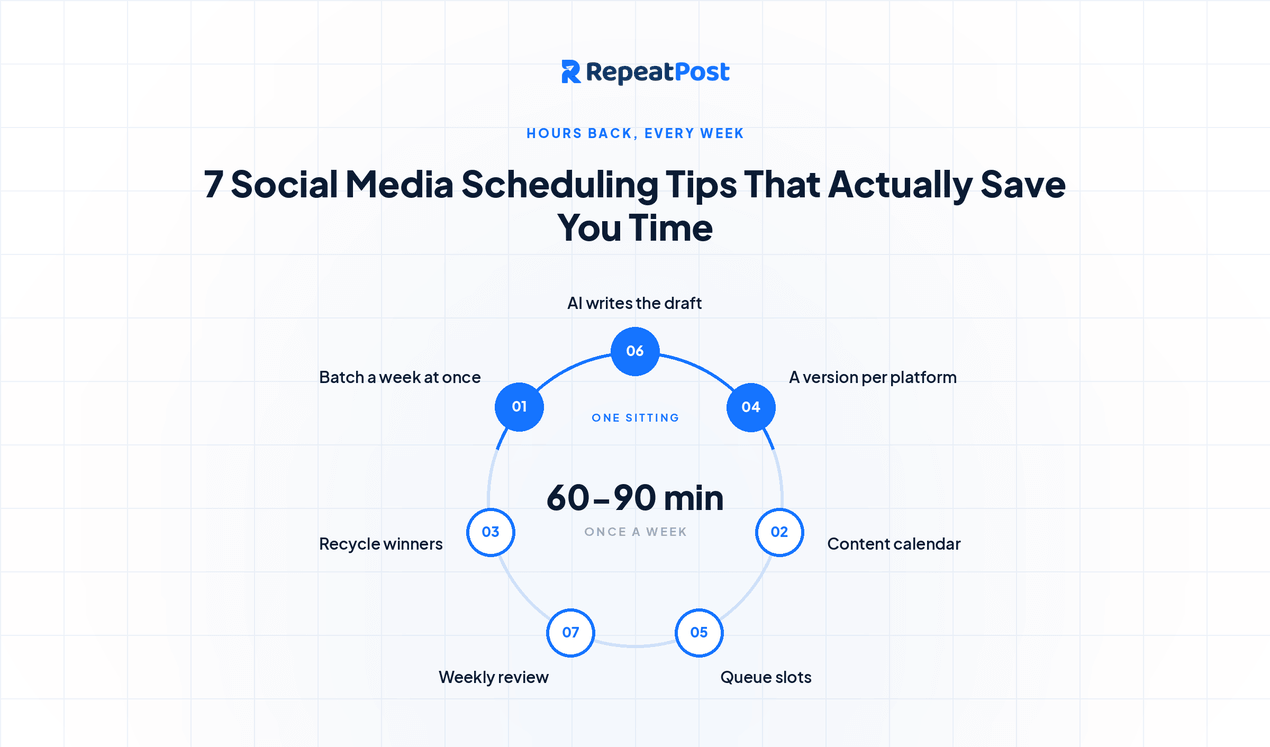
Seven practices the evidence supports
- Set your cadence before your times. Frequency has a measured effect. Hour of day, across four studies of LinkedIn alone, does not even have an agreed direction.
- Batch by format, not by day. If format has a larger effect than timing, and it does, then producing five carousels in one sitting beats producing one of each thing daily.
- Use recurring slots rather than picking times. Decide once, then fill a queue. This removes the daily decision without pretending you have found a magic hour.
- Customise per platform before publishing. Buffer's data shows formats perform inversely across networks: text posts beat video on X, while video beats text almost everywhere else. Identical cross posting fights that.
- Protect against silent weeks. The no post penalty is one of the better evidenced findings here. A queue with two weeks of buffer is insurance against a busy fortnight.
- Review weekly, not daily. Day to day numbers are noise. Buffer's own framing is that these are patterns rather than rules.
- Do not over invest in the hour. Read our LinkedIn timing analysis for how far apart the studies actually are before you spend another afternoon on it.
The short version
Scheduling tools are almost certainly fine. The evidence that they are penalised is thin, dated and format dependent, and the best controlled test found no difference at all.
What is well evidenced is that cadence matters, silence costs you, and format outweighs timing. So put the effort into publishing consistently across 16+ channels rather than into finding a perfect slot, and let RepeatPost's publishing tools handle the queue so a busy week does not become a silent one.
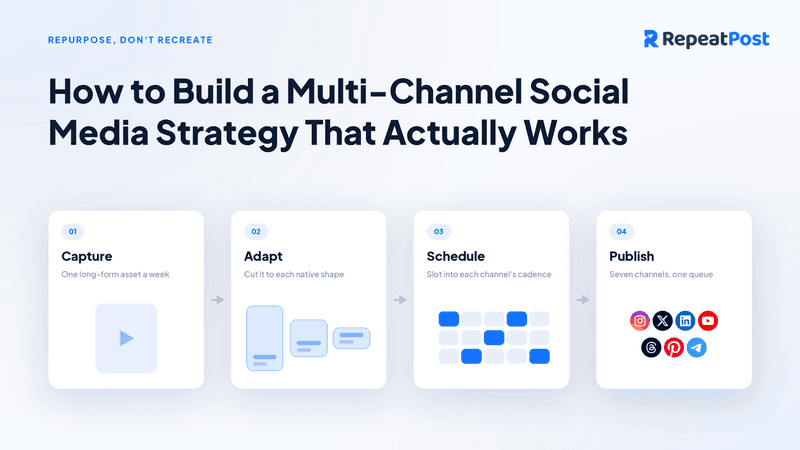
If you are running several platforms, our multi channel strategy guide covers adapting one idea per network, and analytics will tell you more about your own audience than any global benchmark.