Best Time to Post on Instagram in 2026
Seven major studies published in 2026 recommend Instagram posting times that span fourteen hours of the clock. The reason they disagree is more useful than any single recommended slot.
Updated
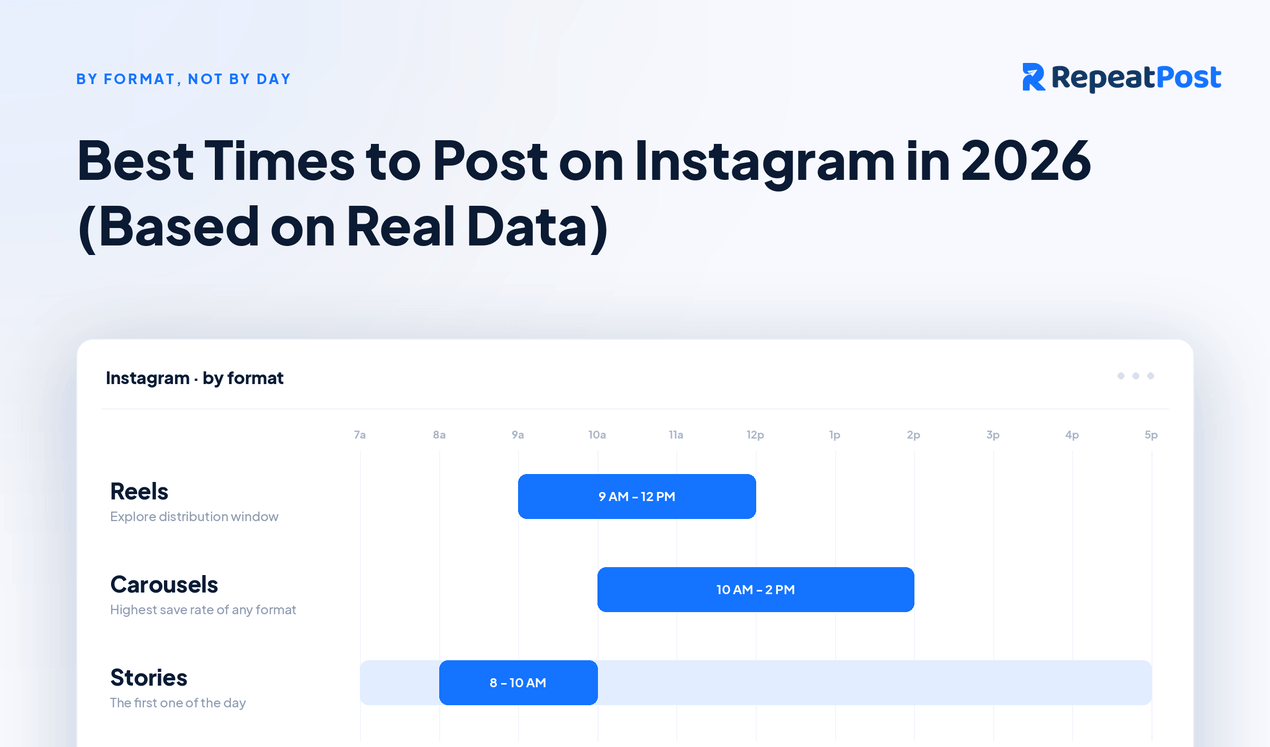
The honest answer is that nobody agrees. SocialPilot analysed 7 million posts and recommends 7 a.m. Metricool analysed 24 million and recommends 8 p.m. Dash Social recommends midnight. Later recommends 5 a.m. Those recommendations span fourteen hours of the clock, and every one of them is drawn from real data.
Understanding why they disagree will do more for your Instagram reach than picking any one of them.
What the studies actually say
Seven publishers ran Instagram timing studies in the last year. Here is the spread.
|
Study |
Sample |
Recommended window |
|---|---|---|
|
Metricool (2026) |
24,364,803 posts, 375,118 accounts |
6 a.m. to 9 a.m., and 8 p.m. |
|
Buffer (2026) |
9.6M posts, 200,000+ accounts |
Thursday 9 a.m., Wednesday 12 p.m. and 6 p.m. |
|
SocialPilot (2026) |
7M posts, ~50,000 accounts |
7 a.m. to 8 a.m. |
|
Sprout Social (2026) |
Pooled across six platforms |
Wednesday 12 p.m. to 9 p.m. |
|
Dash Social (2026) |
750,000+ posts, 1,549 brands |
12 a.m. |
|
Later (2024 data) |
6M+ feed posts, 975K Reels |
5 a.m. |
|
Emplifi (2026) |
399M posts, 754,000 profiles |
Saturday and Sunday, 9 p.m. to 12 a.m. |
On days there is rough agreement. Five of the seven put Tuesday or Wednesday at the top. Emplifi is the exception and names the weekend, which is precisely when Sprout Social and Buffer say engagement is lowest.
On hours there is no agreement at all. Buffer names overnight, 1 a.m. to 5 a.m., as the worst window of the week. Dash Social and Later name almost exactly that window as the best.
The most interesting number in any of these studies
Metricool published the figure that explains the whole mess, and it is buried in its own data rather than in its conclusions.
Reels posted at midnight averaged 25,159 views, from 34,131 uploads in that slot. Reels posted at 6 p.m. averaged 15,928 views, from 119,705 uploads.
The winning hour had roughly three and a half times fewer posts competing in it.
Three of the publishers concede this mechanism in their own copy. Later attributes its early morning finding to less competition. Metricool writes that less competition during those hours may explain the spike in visibility. Dash Social builds its entire midnight recommendation on it.
Which raises a question none of them answer. If a slot performs well because it is empty, what happens when everyone reads the study and moves there? The advice contains the seed of its own expiry.
What Meta's own documentation says
This is where the evidence gets solid, because Meta publishes ranking system cards for each Instagram surface.
The Explore system card lists no recency or post age signal at all. Neither does the Reels Chaining card. The Feed card mentions how recently a post was created, within 90 days, and it sits under the prediction for whether someone will send the post in a direct message rather than under whether they will enjoy it.
The Feed Recommendations card is the revealing one. Under the prediction for how long a viewer will keep scrolling, Meta lists how many impressions that person spends on media aged one to three days, eight to fourteen days, and fourteen to twenty one days.
Meta is modelling each viewer's appetite for content up to three weeks old. Distribution on Instagram is not a same day event.
The counterweight, from Meta's own earnings call
There is a genuine argument on the other side, and it comes from Meta's Chief Financial Officer rather than a scheduling tool.
On the Q1 2026 earnings call in April 2026, Susan Li told investors that ranking improvements had increased the recency of recommended content, with same day posts now representing more than 30% of recommended Reels on both Instagram and Facebook, more than double the level a year earlier.
Freshness has clearly gained weight. Read the same sentence the other way, though, and roughly 70% of recommended Reels are still not from that day. Both things are true, and neither supports agonising over a particular hour.
What the independent research found
Almost everything written about posting times comes from companies that sell scheduling software. There is one exception.
Researchers at the University of Jyväskylä published a formal causal analysis in Statistical Methods and Applications in 2023, using Bayesian modelling on 790 posts. Their findings undercut the entire genre. The best slot changed depending on the type of content within a single account. Their uncertainty ranges spanned roughly a factor of four. And they warned specifically against ranked hour tables, because estimates for adjacent hours are correlated, so comparing them precisely misleads.
A separate 2024 study in the Marketing Management Journal examined 1,052 paid partnership posts on Instagram and found no significant effect of publication schedule on engagement at all.
What actually moves Instagram reach
Format is the larger lever, and the direction depends on what you are optimising.
Buffer's analysis of 52 million posts found Instagram carousels reach a median engagement rate of 6.90% against 3.31% for Reels. But Reels get 36% more reach than carousels and 125% more than single images. Carousels win attention from people who already follow you. Reels win new people.
Frequency is the other lever. Buffer found that moving from one or two posts a week to three to five was associated with roughly 12% more reach per post, and their broader conclusion after 52 million posts was blunt:
the biggest gap in this data isn't between "good timing" and "bad timing." It's between posting and not posting.
One piece of context worth holding while you read any Instagram benchmark: Buffer measured Instagram's median engagement rate falling about 26% between 2024 and 2025, from around 7.3% to 5.4%. If your numbers dropped last year, some of that is the platform, not you.
How to find your own window
Every one of the seven publishers says their table is a starting point. Sprout Social tells you to test against your own account. SocialPilot points you at Instagram's native insights. Later tells you to take its times with a grain of salt.
Here is a method that respects what the evidence actually supports.
- Start midweek. Tuesday and Wednesday is the one pattern most studies share.
- Test two windows that are far apart. A morning slot and an evening slot. Testing 9 a.m. against 10 a.m. is exactly the comparison the Jyväskylä researchers warned is unreliable.
- Hold format constant. Format has a larger effect than hour, so changing both at once teaches you nothing.
- Give it three weeks. Metricool found most Instagram views arrive in the first three days, so a single post tells you almost nothing.
- Check your own audience activity. Instagram's insights show when your followers are online. That beats any global average.
Once you have a window, stop revisiting it. Our guide to social media scheduling covers batching a week of content in one sitting, and RepeatPost's publishing tools let you save recurring slots per channel so you are filling a queue rather than picking a time each morning.
The short version
Post midweek. Pick a window your own analytics support. Then stop thinking about it.
The hour is a small multiplier on a post that already has to earn attention, and it may be measuring nothing more than which slots your competitors have left empty. Spend the effort on format instead: Reels for reach, carousels for depth, and enough consistency for either to compound.
Patterns differ by platform, so compare this with our companion pieces on LinkedIn, TikTok and X. If you are running Instagram alongside other channels, RepeatPost connects to 16+ channels from one calendar with analytics built on your own posting history rather than somebody else's averages.