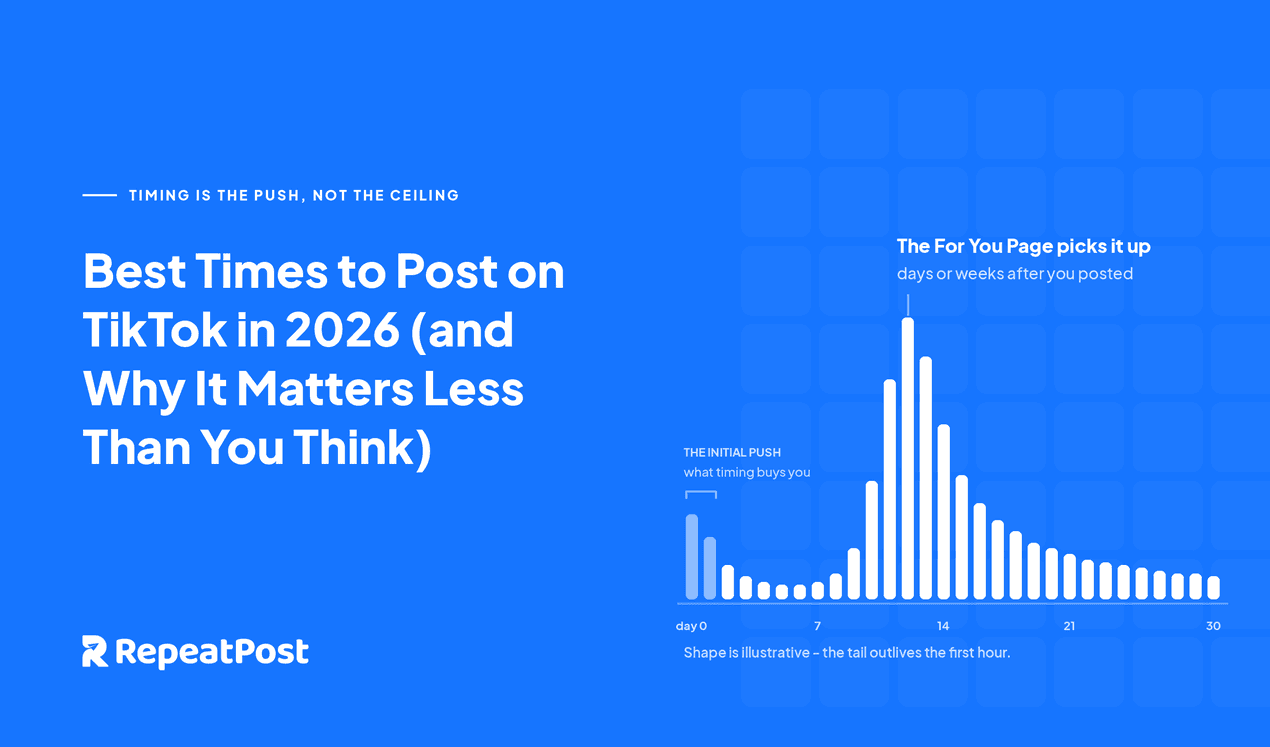
Best Time to Post on TikTok in 2026
Three major studies call Sunday the best day to post on TikTok. Three call it the worst. All six analysed millions of posts, and the contradiction is more instructive than any of their recommendations.
Updated
Three major studies published in 2026 name Sunday the best day to post on TikTok. Three name it the worst. All six analysed millions of posts.
That is not a rounding error or a difference of opinion. It is a direct contradiction about the most basic question in the category, and it should change how you read every posting time recommendation you encounter, including the ones below.
The Sunday problem
Here is the split, with each publisher's own wording.
Sunday is the worst day
- Sprout Social: "Sundays are the worst day of the week to publish content on TikTok"
- SocialPilot: worst day Sunday, best days Tuesday, Wednesday and Thursday
- Emplifi: worst is weekends, especially Sunday
Sunday is the best day
- Buffer: "the best time to post on TikTok is Sunday at 9 a.m."
- Dash Social: "Sunday is the top-performing day for views and engagement"
- Metricool: top days are Sunday evening, followed by Monday
The hours contradict just as sharply. Sprout Social's peak window is Tuesday to Thursday, 2 p.m. to 6 p.m. Dash Social tells you explicitly to avoid mid afternoon weekday posts between 2 p.m. and 6 p.m. because engagement dips. Those are the same hours, from two 2026 publications.
SocialPilot names 11 p.m. to 3 a.m. as the worst window. Dash Social measures its highest engagement rates of the entire week in almost exactly that range, 5.9% at 4 a.m. to 5 a.m. on Sunday and 5.8% between 11 p.m. and 2 a.m. on Monday.
Why six large studies can contradict each other
None of these publishers is wrong about its own data. They are describing different populations and measuring different quantities.
Each sample is one company's customer list. Buffer measured 7.1 million posts sent through Buffer. SocialPilot measured 700,000 posts from accounts connected to SocialPilot. Dash Social measured 289,079 posts from brands using Dash Social. None of these is a sample of TikTok. They are samples of scheduled, marketer produced content, which behaves differently from the spontaneous posting that makes up most of the platform.
Buffer states this plainly, which is to its credit: its data covers "Buffer users and Buffer-posted content only. It's not a full-platform view of any network, and we don't treat it as one." It also describes its findings as "patterns rather than rules."
The metrics are not the same. Some studies report engagement rate per post, some report views, some report how many users are online at a given hour. Those questions have different answers, and a table that mixes them produces contradictions that are not really contradictions.
Some of the data is older than the publication date. Dash Social's TikTok article was updated in January 2026, but its dataset covers January to December 2024. Later's TikTok page publishes no methodology, no sample size and no date range at all.
What TikTok itself says, and one correction
There is a widely repeated claim that TikTok has said posting time does not matter. That claim is wrong.
TikTok's transparency documentation lists, among the video signals its recommendation system uses, "the time the video was posted." It gives no weighting and does not clarify whether this means recency decay or clock time. But it is there, in TikTok's own words.
What TikTok does explicitly rule out is follower count:
While a video is likely to receive more views if posted by an account that has more followers, by virtue of that account having built up a larger follower base, neither follower count nor whether the account has had previous high-performing videos are direct factors in the recommendation system.
That is the genuinely useful thing TikTok has told us, and it matters far more than any hour. A video from an account with 200 followers enters the same recommendation system as one from an account with 200,000.
One caveat about these documents. TikTok's recommendation pages carry no date. Contemporaneous coverage places the main explainer in June 2020, and it does not appear to have been meaningfully revised since. Meta dates every one of its ranking system cards and updates them; TikTok does not. When you are weighing what a platform has said about its own algorithm, that asymmetry is worth knowing.
What the independent research found
The only formal causal analysis of posting time we could find comes from researchers at the University of Jyväskylä, published in Statistical Methods and Applications in 2023. Using Bayesian modelling on 790 posts, they found the optimal slot changed depending on the type of content within a single account, and that their uncertainty ranges spanned roughly a factor of four.
They also warned against precisely the ranked hour tables that scheduling vendors publish, because estimates for adjacent hours are correlated and comparing them closely can mislead.
That study looked at Facebook, not TikTok, and it is small. It remains the most rigorous treatment of the question, and it points the same direction the vendor disagreement does.
What actually drives TikTok reach
Buffer's conclusion after analysing more than 52 million posts across ten platforms is the most useful sentence in this whole category:
what you post matters most, how often you post matters a lot, and when you post matters least.
On frequency there is a real, measured effect. Buffer found that moving from one post a week to two to five was associated with up to 17% more views per post. Socialinsider, measuring 70 million posts, found the actual average cadence on TikTok sits at about 3.5 posts per week, so two to five is achievable rather than aspirational.
TikTok's own stated signals centre on user interactions: which videos someone finishes, replays, likes, comments on and shares. Those are properties of the video, not of the clock.
TikTok engagement has also held up better than its neighbours. Buffer measured TikTok's median engagement rate at roughly 4.6% in 2025, up about 3% year on year, while Instagram fell around 26% over the same period.
A method that fits the evidence
Given six studies that contradict each other, copying any one of their tables is not a strategy. Here is what the evidence does support.
- Start midweek. Tuesday to Thursday is where the fewest studies disagree.
- Test two windows that are genuinely far apart. Afternoon against late evening. Testing 2 p.m. against 3 p.m. is exactly the comparison the Jyväskylä researchers called unreliable.
- Post enough to learn anything. At two to five videos a week you will have a readable pattern in a month. At one a week you will not.
- Hold the content type steady while you test. A change of hook or format will swamp any timing effect.
- Read your own analytics. TikTok shows you when your followers are active. That single number beats every table in this article.
Then leave it alone. Our guide to social media scheduling covers batching, and RepeatPost's publishing tools let you queue TikTok videos into recurring slots so posting cadence stops depending on you remembering.
The short version
Post midweek, twice a week or more, and stop optimising the hour.
Six studies of millions of posts cannot agree whether Sunday is TikTok's best or worst day. That tells you the effect they are all chasing is small, unstable, and specific to each audience. Meanwhile TikTok has told us plainly that follower count is not a ranking factor, which means the distribution ceiling for a good video is the same whether you have two hundred followers or two hundred thousand.
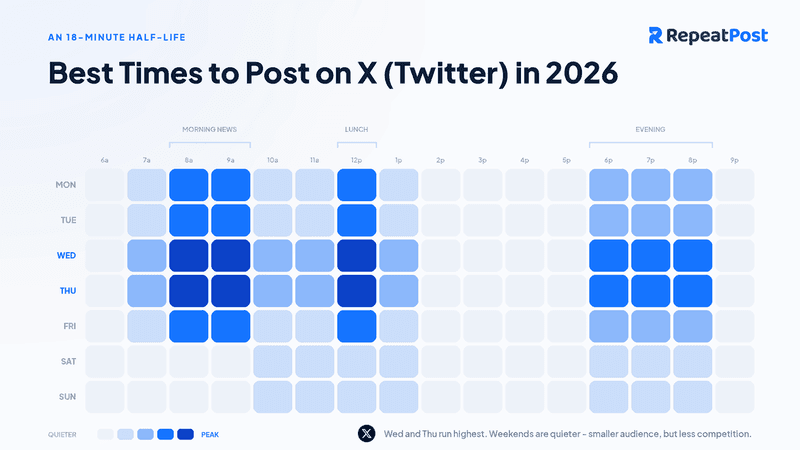
Patterns differ by platform, so compare this with our pieces on Instagram, LinkedIn and X. If you publish to TikTok alongside other channels, RepeatPost connects to 16+ channels with analytics drawn from your own history.