Best Time to Post on X (Twitter) in 2026
Four independent studies agree on the best days to post on X, the strongest consensus in this category. It still matters less than one account setting that changes reach by roughly ten times.
Updated
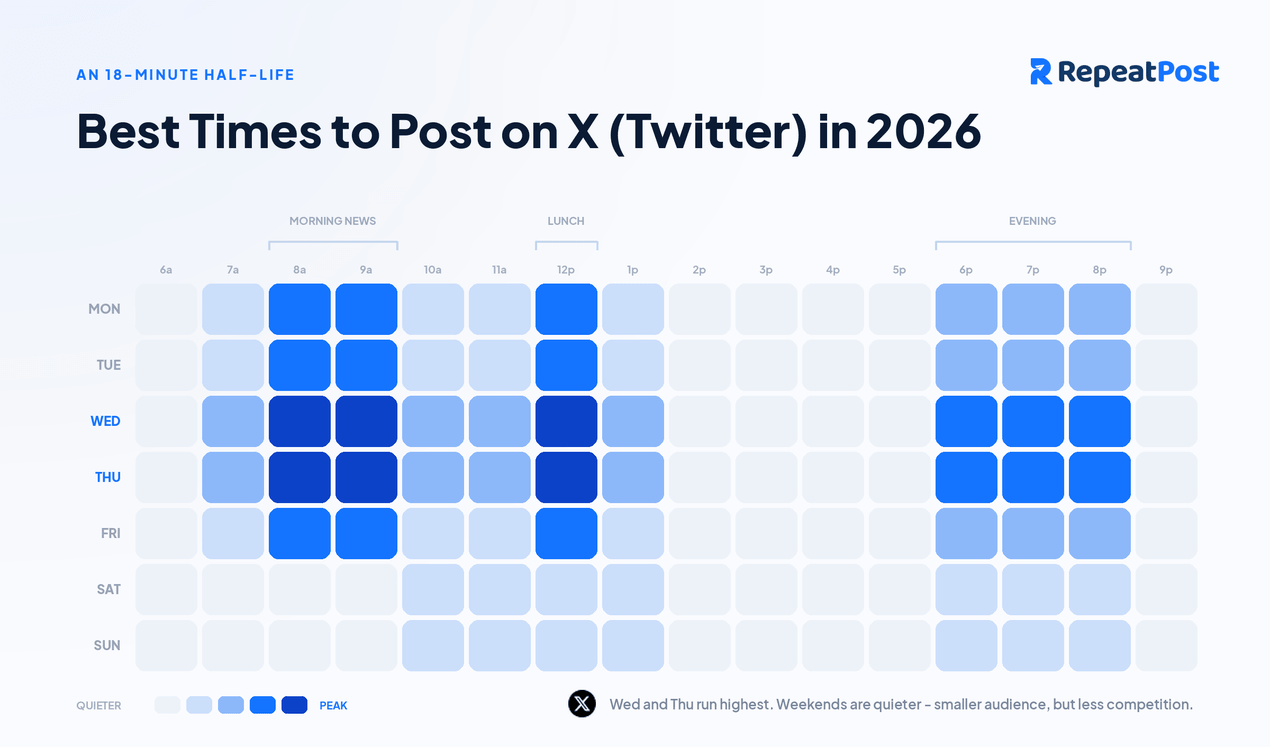
Four independent studies agree that Wednesday, Tuesday and Thursday are the best days to post on X. That is the strongest agreement you will find anywhere in this category, and it is worth knowing.
It is also almost irrelevant next to a single account setting that changes reach by roughly ten times.
Start with the finding that dwarfs the rest
Buffer analysed 18.8 million posts from 71,000 accounts between August 2024 and August 2025, of which about 27% held X Premium. The gap it measured is not subtle.
Premium accounts received around 10 times more reach per post than regular accounts. In median impressions per post: regular accounts under 100, Premium around 600, Premium Plus over 1,550.
The engagement rate split is starker still. Buffer found that after January 2025, Premium and regular account engagement rates diverged sharply, and that in the most recent months of the study the median engagement rate for regular accounts hit 0%.
Buffer notes that Premium users might simply have larger audiences, but adds that follower size alone does not account for the difference.
No hour of the day competes with that. If you are choosing between optimising your posting schedule and reconsidering your account tier, the evidence points firmly at one of them.
The days everyone agrees on
With that established, the timing data is unusually consistent here.
- Buffer, 8.7 million posts: "The best day of the week to tweet is Wednesday," then Tuesday, then Thursday
- Sprout Social, 2026: Monday through Thursday, peaking Tuesday to Thursday
- SocialPilot: "Tuesday, Wednesday, and Thursday are the days that get maximum engagement"
- Metricool: "Wednesday is the best day to post followed by Tuesday and Thursday"
Four datasets, four times the same answer. Compare that with TikTok, where three studies call Sunday the best day and three call it the worst, and you can see how unusual this level of agreement is.
Saturday is named the worst day by Buffer, Sprout Social and SocialPilot alike.
The hours are less settled
Buffer's finding is the cleanest: the best slot is 9 a.m. on Tuesday, and either 9 a.m. or 10 a.m. tops every single day of the week. Its separate 52 million post report independently gives 6 a.m. to 11 a.m. on weekdays, peaking Tuesday at 9 a.m.
SocialPilot broadly agrees, favouring 7 a.m. to 11 a.m. Eastern.
Sprout Social disagrees, favouring 12 p.m. to 6 p.m.
Then there is Metricool, which names 9 p.m., and this is where a real distinction matters. Metricool defines 9 p.m. as the hour with the highest average number of connected users. Buffer's 9 a.m. is an engagement rate per post figure. Those are different questions with different answers, and treating them as contradictory misreads both.
It is worth sitting with that, because it explains a lot of the noise in this genre. The time when the most people are online is not the time when a post earns the most engagement. More people online also means more posts competing for them.
Buffer, incidentally, names evenings from 6 p.m. to 11 p.m. as the worst window for engagement, which is precisely when Metricool measures peak users online. Both can be true at once.
What X's own code says
X is the only major platform that publishes its ranking algorithm openly. The For You code sits on GitHub under an Apache 2.0 licence, and anyone can read it.
That makes one widely repeated claim checkable, and it does not survive.
Tweets do not have an 18 minute half life. That figure comes from 2014, when the timeline was chronological and X was a different product. Reading the published code, the only age related mechanics are a filter that removes posts older than 48 hours before scoring, and a 24 hour window during which new authors receive a visibility boost. There is no engagement score decay or half life parameter in the published configuration.
Sprout Social states that a post loses half its potential visibility score every six hours. That figure does not appear in X's published code either. If you use it, attribute it to Sprout Social rather than to X.
The scoring model itself is a weighted sum of predicted actions. A reply carries ten times the weight of a like, a quote the same, and sharing via direct message rather more. But X includes a warning about reading those weights that is worth quoting, because the misreading is so common:
The weights scale the predicted probabilities of such actions ... they do not scale the raw engagement counts, so e.g. it'd be incorrect to see that a report has 468 times higher weight than a like and conclude that e.g. "1 report cancels out 468 likes".
A related claim, that a reply is worth 27 times a like, comes from the 2023 release of an earlier version and was never updated. The current published weights put the ratio at ten.
Why timing still has a mechanism
The For You timeline is not chronological. Sprout Social notes that the Following tab is reverse chronological but receives significantly fewer organic impressions, because X defaults users to For You.
Under algorithmic ranking, timing works indirectly. Buffer explains the mechanism: one of the strongest signals used to rank posts is how quickly a post gathers engagement, so publishing when your most engaged followers are around gives it the best chance of early momentum.
Buffer answers the underlying question directly. Yes, posting time still matters on X, even with an algorithm controlling the feed, because posts published in certain windows consistently earn higher engagement rates.
Just not by anything like ten times.
Frequency matters more here than elsewhere
X rewards volume in a way other platforms do not. Buffer's frequency guidance puts X at three to four posts per day, against three to five per week for Instagram and TikTok. Socialinsider, measuring 70 million posts, found the actual average sits around 16.3 posts per week.
That changes what a posting schedule means. On LinkedIn you are choosing an hour. On X you are choosing a cadence, and the specific hour of any individual post matters proportionally less because you are publishing several a day anyway.
One note on platform benchmarks. Buffer puts X's median engagement rate at roughly 2.5% for 2025, up 44% year on year. Socialinsider puts it at 0.12%, down from 0.15%. That is a twentyfold gap, and it is not an error by either. They measure different denominators across different account populations, Socialinsider tracking brand pages by follower count. Never average figures like these, and never present them side by side without explaining why they differ.
A method that fits the evidence
- Post midweek. Tuesday to Thursday, agreed by four independent datasets. This is the one recommendation in this article with genuine consensus behind it.
- Favour weekday mornings, but test. Buffer and SocialPilot point at mornings; Sprout Social points at afternoons. Your audience decides.
- Increase cadence before you optimise timing. Moving from one post a day to three or four will do more than moving one post from 2 p.m. to 9 a.m.
- Reply to people. Replies carry ten times the weight of likes in the published scoring model, and conversations keep a post alive.
- Weigh Premium honestly. A roughly tenfold reach difference measured across 18.8 million posts is a bigger lever than everything else in this article combined.
Then automate the cadence, because three to four posts a day is not sustainable manually. Our social media scheduling guide covers batching a week at a time, and RepeatPost's publishing tools let you build a daily queue and fill it in one sitting.
The short version
Post Tuesday to Thursday, in the morning, several times a day, and reply to people who reply to you.
Then stop. The consensus on days is real, the disagreement on hours is genuine, and the effect size of both is small next to cadence and account tier. The 18 minute half life you have read about is from 2014 and appears nowhere in the code X publishes today.
Patterns differ by platform, so compare this with our pieces on Instagram, LinkedIn and TikTok. If you post to X alongside other channels, RepeatPost connects to 16+ channels from one calendar with analytics built on your own history.