What Is RepeatPost?
RepeatPost is the AI social media management platform for planning, creating, scheduling and analysing content across 16+ channels from a single calendar.
Updated
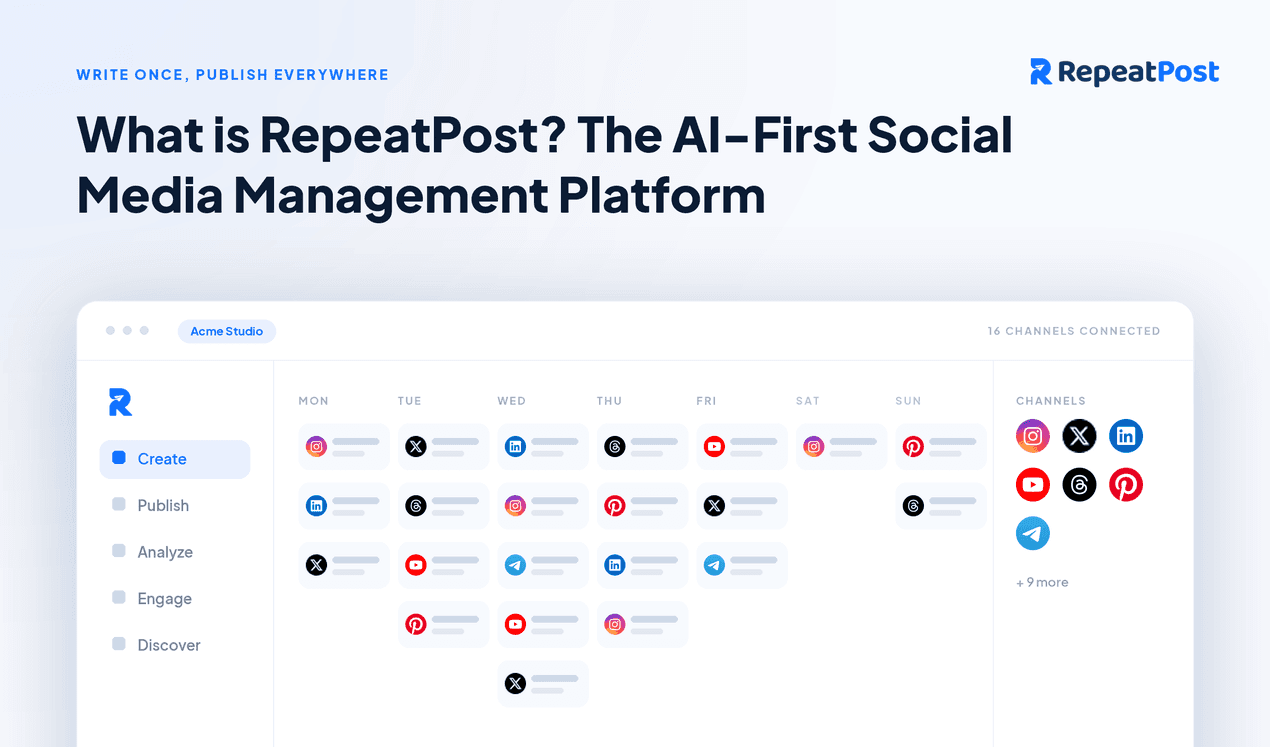
RepeatPost is an AI social media management platform that lets you plan, create, schedule, publish and analyse content across more than 16 social channels from a single calendar.
That sentence describes a category with a lot of entrants, so this piece is mostly about what the category actually does, where the real work goes, and where RepeatPost sits.
What these platforms are for
Two independent analyst firms have published taxonomies of this market, and they converge on roughly the same four jobs.
Publishing and scheduling. Getting content onto several platforms without doing it manually at the right moment each time.
Listening and analytics. Knowing what happened after you published, and what people are saying.
Asset and workflow management. Keeping media organised, and moving content through drafting, review and approval, particularly when more than one person is involved.
Risk and compliance. Controlling who can publish what, and to which account.
Most people arrive for the first job and stay for the third. Scheduling is the visible problem. Workflow is the one that actually consumes time once more than one person or one client is involved, and Planable's survey of 1,000 marketers found approvals to be the single largest bottleneck, affecting over 40% of respondents.
For context on scale, Fortune Business Insights put the social media management market at $32.48 billion in 2025, growing to a projected $39.14 billion in 2026.
The problem worth naming
Managing several channels manually degrades in a specific way, and it is not really about time.
The average person uses about 6.5 social platforms a month, and brands run 4.5 profiles on average according to SocialBee's analysis of 9.3 million posts. Planable found 21.7% of marketers juggle five or more separate tools, and 37.5% manage social media entirely alone.
So the common situation is one person, several channels, several tools, and no single view of what is scheduled. What breaks is not the posting. It is knowing what is going out, catching the gaps before they happen, and reviewing performance often enough to act on it.
That is why the calendar matters more than the scheduler. A queue tells you what happens next. A calendar tells you what is missing.
What RepeatPost does
One editor, per platform customisation. Write the core content once, then adapt it per channel. This matters because format preferences are close to inverted across networks. Buffer's analysis of 52 million posts found LinkedIn carousels reach a median engagement rate of 21.77% against 3.18% for text, while on X text posts outperform video. Publishing identical content everywhere fights that, and Instagram's Original Content Guidelines target it directly.
AI inside the editor, not beside it. Drafting, variations and hashtag suggestions happen where you are already working. HubSpot found 94% of social media marketers now use AI in some capacity, most commonly for ideation and captions. The friction is rarely the model. It is moving between the model and everything else.
A calendar across every channel. Drag and drop, recurring slots, and a view of the whole month. Buffer's analysis of 4.8 million channel weeks found accounts underperform their own baseline in weeks they go quiet, which is exactly the failure a visible calendar prevents.
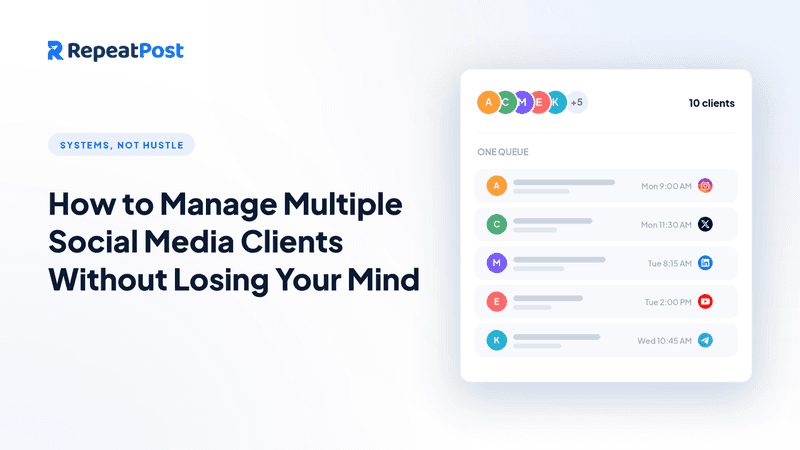
Workspaces, approvals and roles. Separate workspaces per client or brand, approval states that are visible rather than inferred from a chat thread, and permissions so drafting and publishing are different rights. This is the part agencies care about most.
Analytics per channel. Compared against your own history rather than a global benchmark, because platform medians move enough to mislead. Buffer measured Instagram's median engagement falling around 26% between 2024 and 2025. An account that declined last year may have done nothing wrong.
Who it is built for
Creators and small businesses managing their own channels, where the constraint is time and the failure is silence during a busy week.
Agencies and marketing teams managing channels for other people, where the constraints are approvals, client separation and reporting. AgencyAnalytics found 46% of agencies produce a client report in under 30 minutes while 11% take more than two hours, and most of that gap is data access rather than effort.
What it will not do
Worth being straight about this. No platform decides what you should say, and the evidence is consistent that this is where results actually come from. Buffer's conclusion after 52 million posts:
what you post matters most, how often you post matters a lot, and when you post matters least.
Scheduling tools address the second of those three well and the third adequately. The first is yours. A tool can make consistency achievable, and consistency is a real and measured advantage. It cannot supply a point of view.
Where to start
You can create an account and schedule your first post without a credit card. If you would rather try something before signing up for anything, there are more than 100 free tools including caption, bio and hashtag generators that need no account.
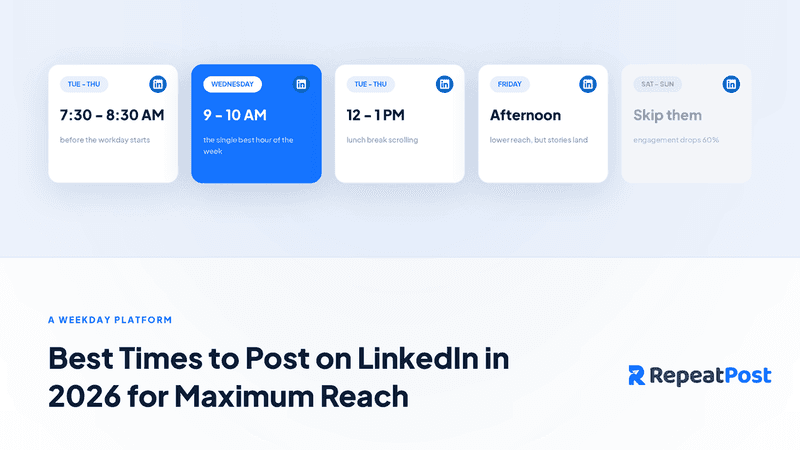
For the underlying strategy, our multi channel guide covers choosing how many platforms to run, the scheduling guide covers batching and cadence, and our platform timing analyses for Instagram and LinkedIn cover what the data does and does not support about when to publish.
You can also see the full channel list, the publishing tools, or pricing.